

Applying next-generation individual-based modeling to improve biological pest control
Weaver: multi-agent, spatially-explicit eco-evolutionary simulation modeling of food webs
Discover how Weaver takes a step forward on the study of ecological interactions through advanced simulations and analyses at multiple scales

About Weaver
Weaver is a next-generation individual based model (sensu Grimm et al. 2017 Ecosystems 20:229-236) that serves to simulate spatially explicit eco-evolutionary dynamics in food webs. It has been extensively updated since its first publication in 2014 (Moya-Laraño et al. 2014 Adv. Ecol. Res. 50:75-143) and the code is Open Source and free to use, thanks to grant TED2021-129653B-I00, funded by MCIN/AEI /10.13039/501100011033 and European Union NextGenerationEU/ PRTR.
We are currently working on a User’s Manual and TRACE document (Grimm et al. 2014 Ecol. Mod. 280:129-139). Among other systems, Weaver has been extensively parameterized to optimize biological pest control in crops, particularly in vegetable greenhouse gardens, being an integral part of what we coined as Food Web Engineering (FWE, Montserrat et al. 2021).
Our simulator
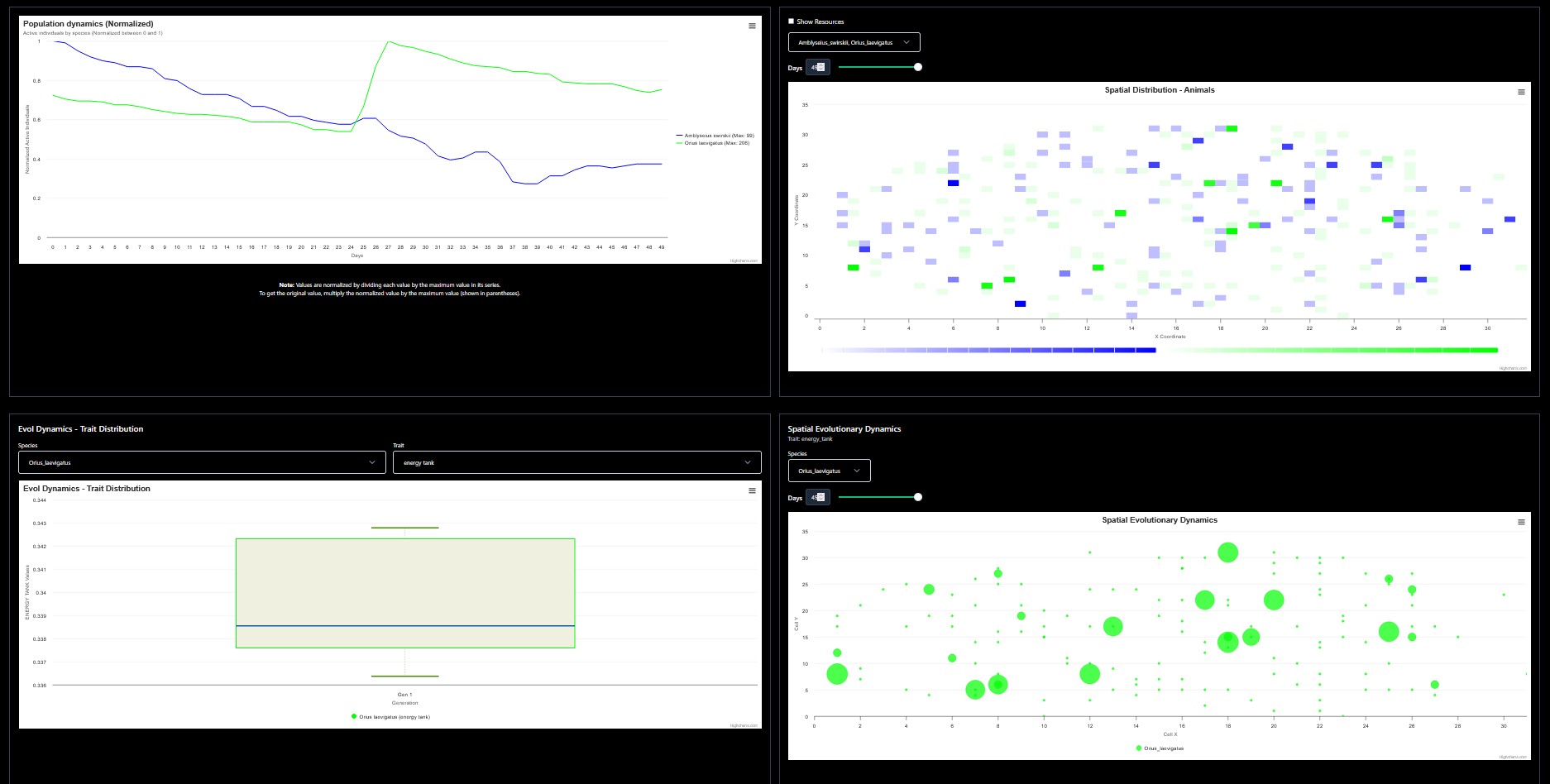
Weaver features
Eco-evolutionary food web Simulation
Simulates Ecology and Evolution in food webs through space
Integrates networks of networks
Genetic-Phenotypic maps, trait modularity, food webs, space
Ecologically comprehensive
Ontogeny of individuals with growth curves and ontogenetic niche shifts
Friendly interface
A GUI interface makes launching simulations easier, serving as a potential teaching tool.
Multidisciplinary and Interdisciplinary collaboration
Uses knowledge from different fields (physiology, quantitative genetics, paleontology) to solve questions in different disciplines (ecology, evolution, biological pest control, paleontology)
Flexibility and adaptability
The same algorithms can be used for different ecosystems. Any new data on a system can be incorporated to improve accuracy
Download weaver to answer research questions or for teaching purposes
Try Weaver and explore its possibilities
Address
Att. Jordi Moya-Laraño, Estación Experimental de Zonas Áridas, EEZA-CSIC, Carretera de Sacramento, 04120-Almería Spain